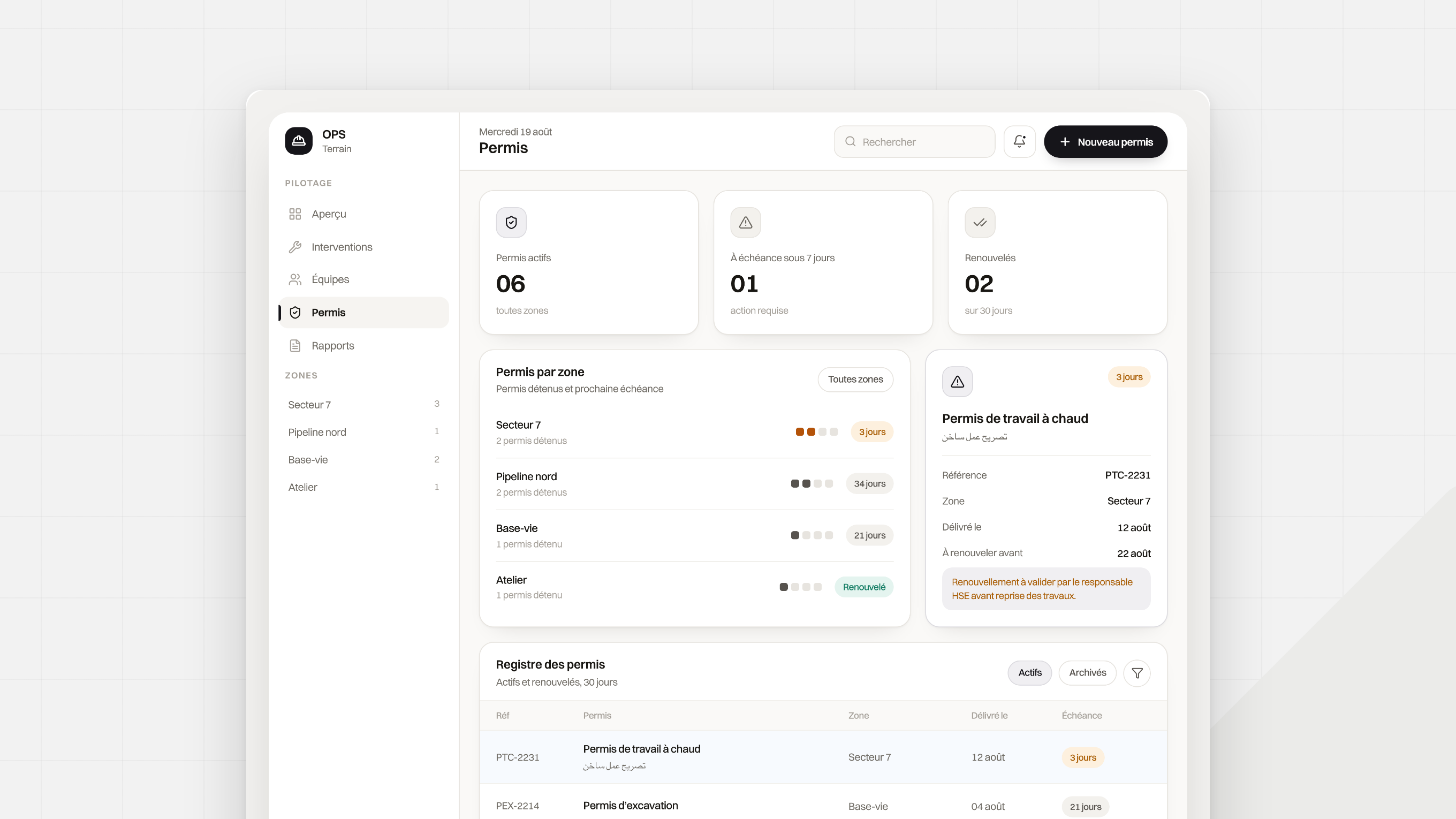
Multilingual is easy to scope as a content problem and cost as one. In operational software serving a region where the paperwork is bilingual, it is a structural problem, and the cost of discovering that late is not linear.
Enterprise software can arrive in a market with a language file and an assurance that localization is supported. Supported can mean no more than the substitution of strings, leaving out the direction those strings run in, the shape of the numerals beside them, the side of the screen a label belongs on, the way a table sorts, and the fact that a single document may contain both scripts at once and must remain legible in both.
For an organization operating where the regulatory paperwork is in one language and the working language of the crew is another, that gap is not cosmetic. It determines whether a permit register can be read at all.
What actually breaks
Layout mirroring is the visible part and the easiest. Padding, iconography, progress direction, the position of a back control, the order of columns in a table — all of these flip, and a system that has hard-coded left and right rather than start and end has to be revisited everywhere at once.
The harder part is mixed content. A permit reference, an equipment tag and a date can be Latin characters and Western numerals inside an otherwise right-to-left sentence. Getting that to render correctly and unambiguously — so that a reference number is never read backwards and never reflows into the wrong side of a cell — is not a styling exercise. It reaches into how the data is stored and how each field is typed.
Then there is everything that is neither layout nor text: sort order, search behavior, text input that has to accept either script in the same field, exports that have to survive being opened in a spreadsheet on somebody’s laptop, and printed output that may be the artifact the organization actually relies on.
The cost curve
Designed in from the start, bidirectional support is a constraint on how components are written. It is a discipline rather than an expense: use logical properties, type the fields, never assume a numeral system, and test both directions from the first screen.
Retrofitted, it is a rewrite of the presentation layer conducted under deadline, and the failure mode is worse than the effort — the product ships with the second language supported everywhere except the places nobody thought to check, and those places are found by the users who most need them to work.
OPS carries three languages, including full right-to-left Arabic. That structure is the reason the permit screens can hold a hot-work permit with its reference and dates in one script and its title in another, in the same row, without either becoming ambiguous.
For anyone specifying a system
Put the second language in the first release of the specification, not the second phase of the roadmap. Ask for a screenshot of the most data-dense screen in both directions before signing anything. A supplier whose architecture already supports it can show you one; a supplier whose answer is a conversation about timelines is telling you it does not.
Recalibre · OPS is in development. Every screen shown carries demonstration data.