
/01
Agentic AI and automation.
AI agents, document intelligence, workflow automation, approval processes and operational alerts — with human oversight where a decision carries weight.

05
Capabilities, delivered by one team
03
Stages in the engagement model
Recalibre is a strategy, design and technology firm. We work with organizations modernizing their operations, their customer experience and their digital infrastructure — and we deliver all five capabilities with one team and one point of accountability. Strategy, design, agentic AI, automation and engineering are one integrated capability, carried by one team. The people who agree what should change are the people who build it, so there is no handover between the thinking and the work, and one person is accountable for both.
START A CALIBRATION
05
Capabilities, delivered by one team
03
Stages in the engagement model
02
Products in development in-house
01
Point of accountability
The alternative is three suppliers and the gaps between them: a strategy nobody can build, a design nobody costed, a system that does what was specified rather than what was needed. Those gaps are not a service anybody sells, and they are not free.
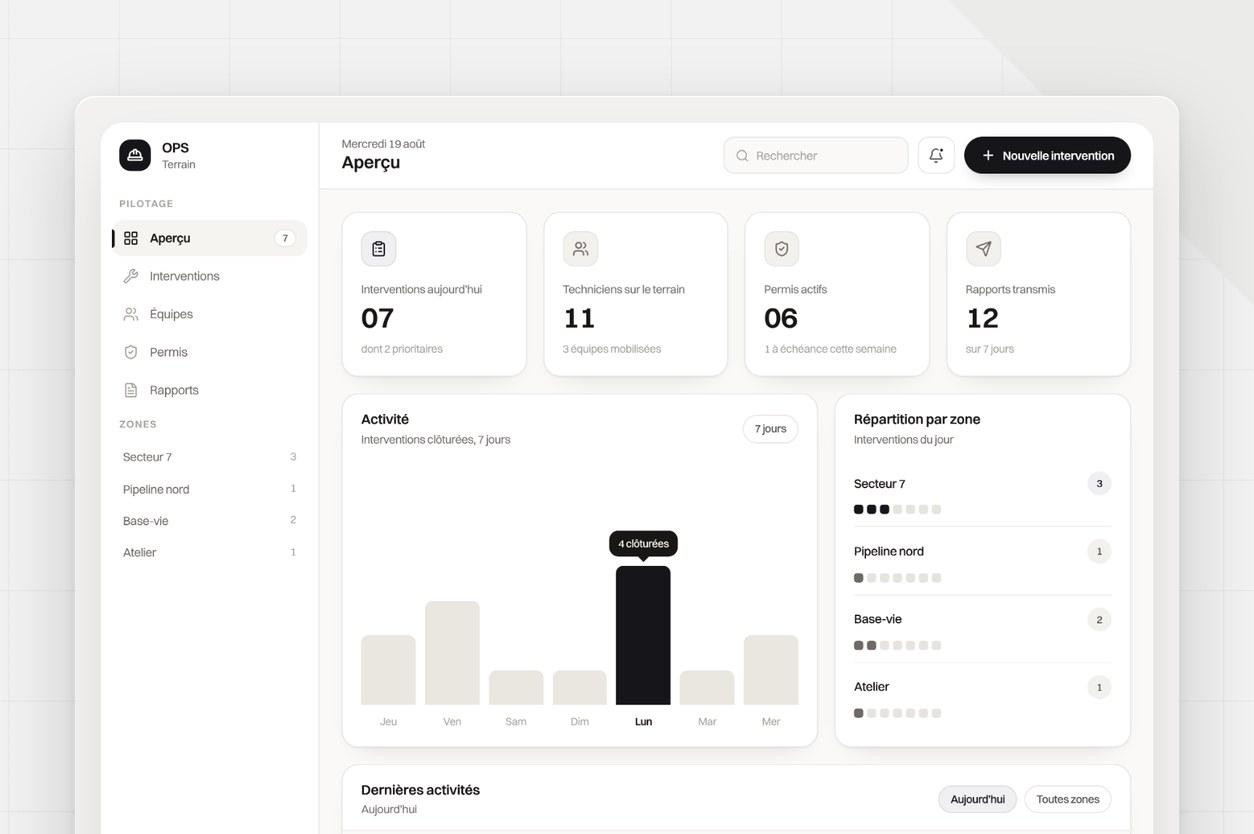
It is also why we build our own products. OPS and Contraxis are where the methods are worked out on real constraints before they are applied to anyone else’s operation. Both are in development.
THE STAGES
THE DISCIPLINES
The founder runs every engagement from the first assessment to the handover. The person who scopes the work is the person who reports on it, and the person you raise a problem with is the person who can change what happens next.

01
What the organization is trying to change, what it is constrained by, and which of those constraints are real.
02
Product strategy, information architecture, interface and experience, and the standards that hold them together.
03
Where a system can decide, where it may only propose, and what a person is shown when they are asked to approve.
04
The handoffs between systems, and the operational data that has to be right before any of it can run.
05
The platform, the integrations, the deployment model and the documentation that lets you own it afterwards.
Named to you in writing at the start of the engagement, and unchanged through it.
Five capabilities, one team. You brief once and the same team carries it through to production.
/01
AI agents, document intelligence, workflow automation, approval processes and operational alerts — with human oversight where a decision carries weight.

/02
Internal platforms, executive dashboards, client portals, workflow applications, field tools and reporting systems, designed around how the organization actually operates.

/03
Connected operational environments that integrate departments, consolidate information, modernize legacy workflows and establish one reliable source of operational data.

/04
Product strategy, information architecture, interface and experience design, prototyping, responsive layouts, accessibility and design systems that scale past the people who wrote them.

/05
Positioning, identity systems, digital brand expression, campaign direction and the standards that hold an identity together across every customer and employee touchpoint.

Where the work actually is.
Design, engineering and automation as one program.
Continuity after launch.
Design, validation and handover sit inside Build rather than beside it. Every engagement starts with a fixed scope agreed in writing, and commercial terms are set against that scope.
One program across five capabilities: agentic AI and intelligent automation, custom software development, enterprise systems and integration, digital product and experience design, and brand strategy and identity. You brief once. The same team carries it from the operating model through to the system in use, so there is no gap between the people who designed it and the people who built it.
Calibration, then Build, then Partnership. Calibration establishes what is worth changing and produces a written plan you keep whether or not you continue. Build runs design, engineering, automation and implementation as one program in controlled phases. Partnership is support and adaptation after launch.
Deployment is designed to keep operational data inside the organization that owns it. OPS, the field operations product being developed in-house, is built to be self-hosted: one server, one database per organization. The same principle applies to client systems — data residency and access are agreed during Calibration and written into the scope, not decided afterwards.
Automation drafts, routes, checks and proposes. Where a decision carries weight — money, safety, a contractual commitment — the system presents it to a person together with the trail that produced it, and that person decides. Which decisions those are is agreed explicitly in system design.
Integration is one of the five capabilities rather than an afterthought. The work consolidates information across departments, modernizes legacy workflows and establishes one reliable source of operational data. What connects to what, and in which direction, is mapped during Calibration before anything is built.
You do. The system, the source, the documentation and the operational knowledge transfer to your organization. Partnership is a service we provide afterwards because organizations change, not a dependency engineered into the handover.
Recalibre®Describe the operational problem in your own words. We will tell you whether it is a strategy problem, a systems problem or a design problem — and what a Calibration would cover.
YOU